

The 2015 Mariners: The good, the bad and what comes next
What we saw, what we learned and what's next for the Mariners after a disappointing season that ended Sunday.
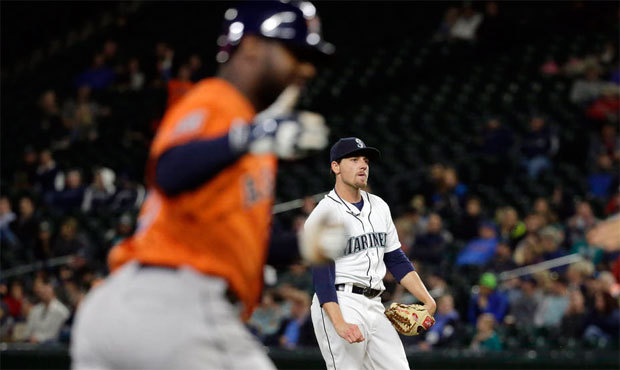
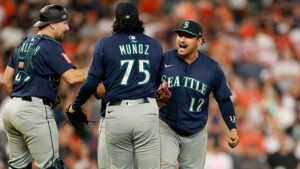
The performance of the Mariners' bullpen was arguably the biggest disappointment of the 2015 season. (AP)
(AP)
The Mariners’ 2015 season is in the rear-view mirror. There were times it seemed this season screamed for a do-over, but sadly, in this sport there are four wild cards but no mulligans.
Visions of postseason play at Safeco Field were thrown into doubt quickly this year despite the Mariners being the darling of the national media in spring training. Six months after being anointed a favorite, it is “what next?” instead of “who’s next?” for the Mariners. Disappointing yes, but the season wasn’t without its moments.
The Good
The No. 1 good development to come out of a bad season is that important questions were answered. We know what the Mariners have and we know what they need.
We saw plenty of good in the middle of the order as it eventually performed the way most expected it would. When some were starting to wonder if Robinson Cano was hitting his major regression years prematurely, he turned around and ranked in the top 10 in the American League in average, on-base percentage and wRC+ for the second half of the season – and he did so playing hurt.
While Kyle Seager’s season was a bit of a mystery with phenomenal success against lefties but trouble with runners in scoring position, overall I think you could say he took a modest step forward and built off a good 2014.
Then there was Nelson Cruz. No chance he would ever hit 40 home runs again and certainly not at Safeco Field, right? Wrong. And do so while hitting .300, a number I have little doubt would have been higher had he not injured his quad in early September. He was remarkable, putting up career highs in home runs, hits and walks. He also posted career highs in average, on-base percentage and OPS in seasons where he had over 450 at-bats. It was a tremendous year for Cruz, who turned 35 in July.
From the oldest player on the roster not named Joe Beimel to the youngest, Ketel Marte answered questions and lands firmly in the good category for 2015. The advance notice on Marte was wrong; he clearly can play shortstop. While new general manager Jerry Dipoto could have his eyes open for a more proven shortstop to take at least some of the at-bats there or provide better-than-backup insurance, the position is no longer a pressing need to fill. Marte’s ability to hit leadoff is a bonus.
After years of searching for a leadoff hitter, this one was progressing through the minors all the while, mainly as a No. 2 hitter. Marte told me he was a bit more aggressive hitting second but quickly realized that with the bats behind him at the big-league level, his job was simple: Get on base. He has done that to the tune of a .349 OBP, good for second-best on the team and fifth best – with the fourth lowest strikeout rate – for American League rookies with 200 at-bats or more.
There is the matter of at-bats, but 243 is significant. I did see pitchers make adjustments with Marte, and Marte adjusted right along with them. His knowledge of the strike zone and ability to bunt for a hit should help lessen slumps when they come. I think he has demonstrated that he certainly can lead off at the big-league level if needed. With the search for athletic outfielders a priority, there is a chance he could have competition for the leadoff spot, but it appears likely we will see him in the lineup somewhere.
On to the pitching.
Felix Hernandez stayed healthy and pitched 200 innings. It wasn’t one of his best years but I’m not ready to sound any Felix alarms quite yet. Second-half Hisashi Iwakuma also falls into the good category. He was my biggest question mark heading into the season. His second half of 2014 was alarming and I was concerned it was the beginning of the end for Iwakuma. Instead, what we saw from him in the second half was much closer to what we saw from 2013, when he finished third in the Cy Young Award voting. It was a belated but good turnaround.
No. 1 in the good department from the pitching staff goes to Taijuan Walker. He took what was perhaps both the biggest and most important step forward for anyone on the team and I for one was surprised by how big a step that was. In 13 years of covering this team on a daily basis, I have seen young pitchers come up, struggle, have some success, survive but ultimately take at least a few years to come into their own. It would appear Walker has accelerated the process. Walker learned how to to prepare this year, and a good amount of credit for that should go to both manager Lloyd McClendon and pitching coach Rick Waits. He learned how to survive when he didn’t have his best stuff and he learned that there is no one he should ever be afraid to throw a strike to. He reintroduced his breaking ball into his repertoire and understood when that pitch was not necessary. Most importantly, he learned how to compete. He pitched 169 2/3 innings and should have no problem reaching 200 next year. It’s a big, big win for Walker and the Mariners going forward.
The final good development is one that I hope for the team’s sake carries over to next year, and that is Edgar Martinez being installed as hitting coach. The numbers are there for the offense as a whole under Edgar and his influence on the hitters – not just behind the scenes in their preparation but during games as well – is obvious. It became silly how many of them wanted to talk in interviews about Edgar and his impact. Outside of the two weeks after he was hired, I did not bring him up in interviews yet just about any conversation with players about offense led to unsolicited comments about him. He clearly has the trust and respect from his hitters, who put up the third-best offensive WAR, the second-best wRC+ and the third-best OPS in the American League in the second half.
The Bad
The Mariners allowed 170 more runs in 2015 than they did the previous year and the bullpen owned a significant chunk of that number, certainly surrendering some of the most critical runs. While some order was restored after jettisoning Fernando Rodney to Chicago and the second reshuffling of the back end, the overall performance of the Mariners’ bullpen was the biggest and perhaps costliest of the season in terms of wins missed. McClendon pointed to the bullpen two months ago as being the biggest disappointment of the season and said so again on the morning of the final game. It is hard to disagree with him.
We saw a total collapse in the first half with five pitchers from last year’s bullpen either sent down, demoted or traded by mid-season. A horrific turnaround with no in-house remedies. Dipoto has pointed to pitching depth as a pressing need – more so than offense – and he will have his work cut out for him while accumulating it as numbers are needed both with relievers and starters.
That leads us to James Paxton, who unfortunately falls under the bad category as well for 2015. For a second straight year, Paxton spent the majority of the season on the sideline. While last year was supposed to be his first big-league season, it was more than an introduction as it afforded him the room to grow and learn the league, and this year Paxton was penciled in as the No. 2 starter. Losing Paxton and Iwakuma – who also missed a good chunk of 2014 – hurt not only in terms of not having their top arms available to pitch every five days but also in the pressure that it put on the bullpen.
With Paxton, the stuff is there and it’s tantalizing, so much so that last offseason he was one of the players that then-general manager Jack Zduriencik was asked most about in trade talks. His value no doubt has gone down but the reality of the situation is he is still under club control, and as frustrating as his injuries have been, his value most likely will still be highest with the team he is currently with. Full seasons from both Paxton and Iwakuma could have been difference makers both this year and last, and in 2016 the Mariners will want to have good insurance for at least one of them.
The next bad development is a trifecta that can be tied neatly together and put under the heading “roster construction.” Home record, outfield defense and hitting with runners in scoring position proved to be a problem from start to finish this year, although some progress was made with RISP as a couple of key hitters turned things around a bit in the second half.
For the second straight year the Mariners had a worse home record than road record. It isn’t a matter of not being able to hit the ball out of Safeco Field. The Mariners did that. They hit as many home runs as their opponents did. The problem is scoring runs in other ways and preventing them from the other side.
That brings us to the outfield defense, which was anything but high flying this year. Both McClendon and Dipoto have stated that this team needs to get more athletic. It needs outfielders who can chase down balls and some speedsters at the top and bottom of the order that can get on for the middle of the order, cause some havoc on the bases, take the extra base and generate the extra runs we didn’t see this year.
So how does hitting with RISP tie into roster construction? McClendon answered that in his final pregame meeting with the media Sunday morning.
“The problem is, we have a lot of swing-and-miss guys, we have a lot of strikeouts,” he said, “and when that happens with runners in scoring position, you don’t score as many runs. It’s one of the things we need to shore up going into next season. We need guys around our core guys that are contact hitters that put the ball in play.”
One of those swing-and-miss guys was Mike Zunino. While his defense was a plus, his offense obviously lands on the bad list for 2015. He was sent to instructional league to rework his swing and it will be interesting to see how Dipoto handles him. Does he go for a full-time catcher in the offseason or has he seen enough from the other side or heard enough from Edgar to believe that only a solid backup will be needed? I have heard that Dipoto is heading to Arizona at the end of the week but I do not know if Zunino will still be there. With a new general manager in place, catcher moves to the question-mark category.
Next
A decision will be made soon with McClendon and the coaching staff. With change at the top there is often change below, and the question right now is how much there will be. This team finished with 11 fewer wins than it did in 2014, but one has to wonder how different if things would have been with a move made here or a move not made there. It is what it is, according to McClendon.
“I think you are what you are every year regardless of how you got there,” he answered when asked if this was truly a 75-win team. “You can talk about the blown saves or the lack of offense in the first half, but it is what it is. The fact that we blew those saves shows that we weren’t good enough. Guys weren’t playing up to their capabilities. We can always say that it could have been this or it could have been that, but you learn in baseball that you are what you are. We were a 75-, 76-win team this year.”
The one thing McClendon was certain of, however, was that he and his team gave all it had.
“I look in the mirror every night and know that I gave it my all every day. And I know that my players gave me all they had every day,” he said. “Some nights it was good enough, other nights it wasn’t. The effort was always there. We just need to shore some things up from a talent standpoint.”
There is a lot needed, but a lot to work with as well. It should be a very interesting offseason.
Related
 Ex-Seahawks safety Coby Bryant out 4-6 months after surgery
 Seahawks set a throwback uniform matchup vs an old rival
 Mariners-Yankees Lineups: No Josh Naylor for series opener
 Seahawks FB Robbie Ouzts to IR, will miss 2026 season
 Based on precedence, a big Mariners run should be coming soon
 Seahawks’ Nick Emmanwori takes big step toward return from surgery

Comments
0 Comments