

Why hasn’t Seahawks’ offense featured more AJ Barner?
Michael Bumpus breaks down why an expected leap in production hasn't materialized for the third-year tight end.

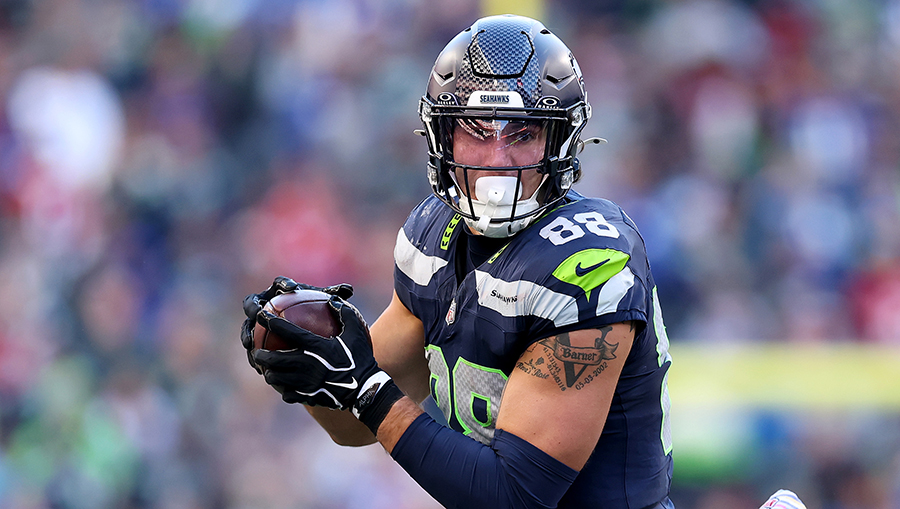
AJ Barner of the Seattle Seahawks catches the ball on Oct. 17, 2026, in Seattle. (Steph Chambers/Getty Images)
(Steph Chambers/Getty Images)
When the Seattle Seahawks hired Brian Fleury to be their next offensive coordinator, there was an expectation among many that the team’s offense would begin featuring the tight end more.
Seattle Seahawks activate Charbonnet; Arroyo out for season, per report
Fleury had come over from the San Francisco 49ers where he spent four of his seven seasons as a tight ends coach leading a room that featured five-time All-Pro George Kittle, one of the NFL’s most dangerous receiving threats at the position for the past decade.
Add in the fact that AJ Barner was coming off a breakout sophomore campaign during the Seahawks’ run to the Super Bowl title last season, and a big year from Barner seemed like one of the easiest bets to make on Seattle’s offense.
But through the first six games of this season, Barner has yet to take another leap forward. He’s actually seemed to take a small step back.
While Barner is still averaging four targets per game as he did last season, he’s caught just 41.7% of those targets this year compared to 63.2% a season ago. He’s averaging just 23 receiving yards per game, down from 30.5 last year. And he’s yet to catch a TD pass, something he had four of at this point last season.
Former NFL wide receiver Michael Bumpus broke down the different factors that have led to an underwhelming first six games for Seattle’s third-year tight end during Thursday’s edition of Seattle Sports’ Bump and Stacy.
“It’s never just one thing,” Bumpus said. “We’ve been justifying or trying to make sense of Sam Darnold’s poor performance over the past couple weeks and saying, look, it’s not just Sam. And when I watched the film with AJ, it’s not just a AJ.”
What Barner can do better
While Bumpus has seen other factors leading to a slow start for Barner, he’s also seen an area the Michigan product can improve on.
“There are a couple of routes where I didn’t like the way he attacked the defender,” Bumpus said.
Bumpus pointed to a seam route Barner ran during last Thursday’s loss to Denver as one of them.
“He blocks for a minute, then he releases and he’s running his route off the second-level defender. And what he did was he tried to influence the defender to bounce outside, so he leans his left shoulder trying to influence that linebacker to overflow,” Bumpus explained.
“The backer doesn’t overflow, AJ assumes (the backer is), then he collides with the backer. Sam is going to him and thankfully the ball got tipped or something because that might have been an interception as well. So right there, he’s not really setting himself up.”
Lack of a run game
The Seahawks have struggled to run the football consistently early this year, which Bumpus sees as a key factor as to why Barner hasn’t made another leap in Year 3.
Bumpus believes tight ends are at their most effective when attacking the middle of the field, and the way to open up the middle of the field is to influence the linebackers with the threat of the run and play-action passes.
“I just think that the lack of run game is not allowing him to get the wide open space that he needs to operate,” Bumpus said. “Tight ends get busy when they’re wide open. It’s rare you have a tight end that is so skilled that one-on-one lining up (he can) route you up and break you down.”
How defenses are approaching Seahawks
Bumpus also highlighted what opposing defenses are running against the Seahawks because of the threat Jaxon Smith-Njigba presents as something that’s hurting Barner’s receiving production.
Defenses are largely running Cover 2 and Cover 4 schemes against Seattle, which give defenders an opportunity to be coming down on Barner when he catches balls in the flats where he is mostly used. Because Barner doesn’t have time to get going, he isn’t able to break tackles with his north-south running.
“So, you chip, get into the flat and guys are flying downhill,” Bumpus said. “No knock on AJ, he’s not the type of player to break someone down and make the miss and make a move like a JSN or somebody. He’s gonna catch it, get up field and try to get north-south.”
Hear the full conversation at this link or in the audio player near the top of this story. Listen to Bump and Stacy weekdays from 10 a.m.2- p.m. or find the podcast on the Seattle Sports app.
Seattle Seahawks news and analysis
• Chiefs star RB Kenneth Walker III downplays his return to Seattle
• The Athletic sheds light on Kenneth Walker III’s departure
• Why potential return may not fix Seattle Seahawks’ O-line issues
Related
 NFL insider floats Seahawks as a Jonathan Taylor trade suitor
 Stacy Rost: 3 numbers to know for Seahawks vs Chiefs
 Seahawks’ Fleury far from only 1st-year OC struggling this season
 Salk: Sam Darnold’s rough stretch will have impact on offseason
 Breakdown: The crux of Seahawks’ offensive struggles
 Seahawks’ latest injury report features mixed news

Comments
1 Comments
The running game is definitely one thing affecting the TE productivity when it comes to the passing game. Hopefully Charbs AND A. Bradford can give us a spark in that aspect. Curious to see if A. Bradford WAS a reason our running game's been good the past few years. We'll find out this weekend. I feel Sam plays better under the center while being able to use play action effectively. Pocket passer, is not his strong suit. Hopefully we can get the defense to respect the running game enough for Sam to have more opportunities under center.