

Stacy Rost: 3 thoughts from Mariners’ end-of-season interviews
What stood out from what was said by Jerry Dipoto, Justin Hollander and John Stanton.

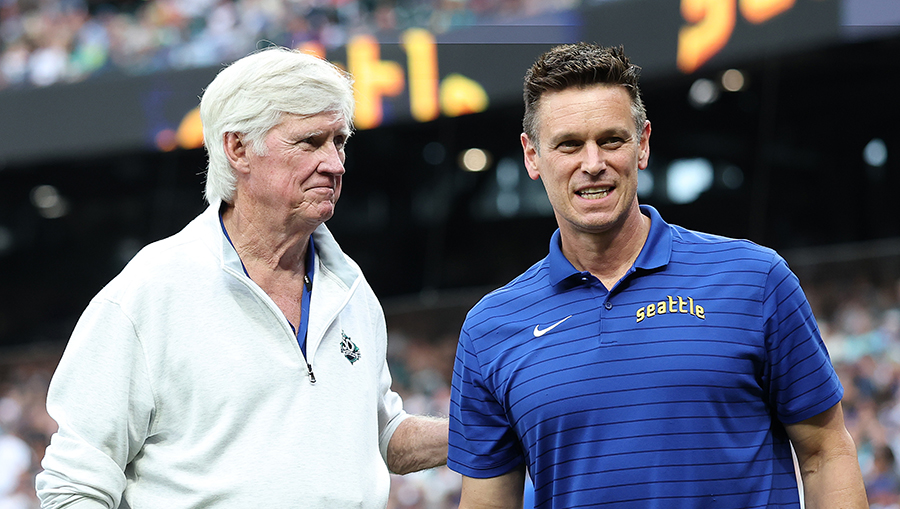
Seattle Mariners president of baseball operations Jerry Dipoto (right) and chairman John Stanton before a game on Aug. 21, 2026, in Seattle. (Steph Chambers/Getty Images)
(Steph Chambers/Getty Images)
A disappointing season from the Seattle Mariners deserves answers, and fans and reporters got some from president of baseball operations Jerry Dipoto, general manager Justin Hollander and chairman John Stanton this week.
Seattle Mariners GM addresses 3 players who had down years in 2026
Here’s what has stuck with me.
• It’s a small thing, but I appreciated that Justin Hollander began his interview by apologizing to fans.
I get it, we’re all mad. I’m mad. You’re mad. You want more than words; you want action. But having seen many an arrogant dismissal of concerns from people in Seattle and outside of the city, I personally appreciated seeing a general manager sound more contrite.
Hollander stopped by the Seattle Sports studios Tuesday for an interview with Brock and Salk and led with this: “You guys deserve an explanation in person. Our fans do, the listeners do. I feel terrible for the way this went. Apologies to everyone who watched the way we played all year. To you guys who had to talk about it, to our fans, to Rick Rizzs. This was not the way it was supposed to go for Rick’s last year.”
He also answered some great questions from Brock and Salk (Why wasn’t something done earlier with manager Dan Wilson? Why was the defense so bad and how are you evaluating it? Why have veteran free agent right-handed bats been a black hole?), and I recommend listening to the full interview.
Now, while I’d acknowledge that an apology is a starting point and that tone matters from baseball executives, it doesn’t solve the problems. Finding answers to those problems is what this offseason needs to be about.
• Effort and accountability were major themes, but what does correcting that look like?
We talked about this all year long. Was it on a player? On a manager? And why wasn’t something done?
“I don’t ever believe in the idea that there’s one accountability cop that walks through the clubhouse,” Hollander said. “I think there’s a perception on our team that Cal (Raleigh) is the leader, he should catch 135 games a year, he should switch-hit, he should hit 40 to 60 homers, and he should have every tough conversation that’s player to player in our clubhouse… I don’t think that works. I think there’s a culture that exists with teams where there are no good cops or bad cops, there are just standards.”
I loved the last line. Because it’s true for every elite team I’ve covered. I’d argue that’s true for the team across the lake right now, and is a huge (and underrated) part of their championship run. There are leaders on every team who can have conversations or step in front of a mic to take accountability when it’s needed. There are coaches who have tough love and make those standards clear. But there’s a universally embraced understanding of the standard, the method, and the goal. To me, that’s what culture means in competitive sports.
My co-host Michael Bumpus shared a quick behind-the-scenes story over the summer to highlight that: a Seahawks player did something — skipping a rep, or perhaps taking a play off… I can’t quite remember what the offense was, but it went mostly unseen — and a team leader gave him a quick and simple reminder: “We don’t do that here.”
There are tough players on this Mariners team. Likeable players. Fun players. Talented players. This isn’t a clubhouse full of toxicity. But it was also a clubhouse that, from the outside, appeared to lack that buy-in, accountability and non-stop effort. Curating that in baseball is an entirely different beast, but Dipoto and Hollander (and those player leaders) should be spending a good chunk of the offseason figuring out how to do it. There’s not a single team that’s won a World Series without it.
• The Mariners will need to make themselves uncomfortable.
This wasn’t something said directly from Dipoto or Hollander. But in listening to Stanton’s interview with KING 5 and reading his Q&A with The Seattle Times, I was struck by the difficulty of the path to contending in MLB.
Part of that is the reality that this team isn’t operating with the budget of the Dodgers or Mets or Yankees. When Stanton balks at the idea of giving a massive 10-year contract to a superstar who won’t be a serviceable starter in the final few seasons of his deal, you can understand the business decision. Whether you agree is a different story — I’ve always been a proponent of bold swings to have payoffs now, particularly for a team that’s never touched a World Series — but I understand the reality that a good chunk of the league faces when it comes to massive gambles. It’s why the draft-develop-trade approach has been utilized from this front office for years.
What’s difficult, though, are the limitations that bigger market teams don’t have. The Mariners have a good group of homegrown talent, and that’s an important step. But how do they round out the edges or add a centerpiece that puts them over the top? The gap between 76 wins this year and 86 next could theoretically be closed with better seasons from its core players (they probably make the playoffs if they get the Aug. 16-Sept. 26 version of Cal Raleigh). But getting 90 wins? 93 wins? It’s a smaller difference from 86 or 88 wins, but it takes substantially more to get there.
It’s been 23 years since the Mariners have surpassed the 90-win mark, and that’s a stretch that includes the single best offensive season from a catcher we’ve ever seen and the best season front to-back from a rotation this team has ever had. Those alone weren’t enough.
So, they’ve got two choices: they can make themselves uncomfortable by spending more, or they can make themselves uncomfortable by trading cheap, young talent. They clearly need to do at least one.
Seattle Mariners news and more
• GM Justin Hollander details what the Mariners have to do better in ’27
• If this was it for J.P. Crawford, he’s left a lasting impact on Mariners
• Drayer: Seattle Mariners focus on accountability, making a shift for 2027
Related
 These four Mariners are set to become free agents
 White Sox sweep Astros out of playoffs with 7-3 win
 Why Hyphen says Mariners need to ink Logan Gilbert to extension
 M’s player from Luis Castillo trade haul elects free agency
 Mariners GM addresses 3 players who had down years in 2026
 AL West: Rangers’ Corey Seager played with bone spur in elbow


Comments
2 Comments
This roster is bad defensively, at every infield position and most of the outfield. It is slow...two of the starting five, Gilbert and Kirby had a combined record in September of 3-7 each with very high OPS AGAINST.
I believe Walter / Gilbert said in his exit interview that he had a feeling that multiple teams were "prepared" for the M's pitching style and they were hunting pitches... which I actually agree with.
That said, I don't think the M's did this or IFFF they did, the M's only did it well in about 6 games... so I hope the new coaching staff will analyze these tendencies / abilities to hunt AND help the players work on these things over the break.
Of course, that will be difficult when they are on strike, but....