

Rost: What’s the Seahawks’ plan for the offensive line?
The Seattle Seahawks' biggest need going into the offseason was the offensive line. So why the lack of moves? Context matters, as Stacy Rost explains.


The Seattle Seahawks offensive line huddles up during a 2024 game. (Steph Chambers/Getty Images)
(Steph Chambers/Getty Images)
The Seattle Seahawks’ single greatest need was much more obvious a few weeks ago.
Seattle finished the 2024 season as Pro Football Focus’ 29th-ranked offensive line. Only five passers were pressured more than quarterback Geno Smith and only four took more hits.
Mock Draft Roundup: What options do Seahawks have at No. 18?
There was a massive question mark at center, where veteran Connor Williams retired midseason and was replaced with Olu Oluwatimi. Would Seattle have yet another new starting center in 2025, a trend that had been continuing for nearly a decade?
Veteran guard Laken Tomlinson, who spent a single season with the Seahawks, has since signed with the Houston Texans, leaving an open battle at either guard position as well.
You could tolerate a down year for an offensive line — a position group the bulk of the NFL has struggled with — were it not a persistent, ongoing, mind-numbing issue. Truthfully, the Seahawks haven’t ever been elite there under this regime. They’ve rarely been good at all.
It’s easy to stomach when this same regime brought Seattle its first Lombardi and saw the winningest head coach and quarterback combination in franchise history. But still, Pete Carroll is gone. Prime Russell Wilson is gone. Marshawn Lynch and the Legion of Boom have long since left. And establishing a great run game — Seattle ranked 28th there last season — feels like a steep mountain to climb without more proven talent up front.
So why the lack of moves on the line?
Context matters
Remember how the offensive line was the greatest need a few weeks ago? That changed because the Seahawks had just sent Geno Smith to the Raiders in a shocking trade. And then they sent DK Metcalf to the Steelers, making him the second veteran wideout to depart this offseason (they’d released Tyler Lockett prior). What was one big question mark on the roster suddenly became three.
The Seahawks worked quickly to address the quarterback question by signing Sam Darnold, the top free agent available, to a three-year, $100.5 million deal (with guaranteed money only in year one, giving Seattle the option to move on if Darnold struggles). They added a downfield threat to the receiver room by signing Marquez Valdes-Scantling and continued to add by aggressively pursuing, and later landing, former Rams All-Pro receiver Cooper Kupp.
Cooper Kupp grew up watching the Seahawks, now he plays for them
Offensive line remains the biggest need now, and a single move in free agency (signing swing tackle Josh Jones to a George Fant-esque role) has very fairly left fans frustrated.
At least one move didn’t work out
The Seahawks were reportedly aggressively pursuing another name in free agency: Will Fries.
The veteran guard was one of the top interior linemen available, and one Seattle was very interested in signing. It’s the kind of move that is atypical of a front office that’s normally quiet in free agency, focusing instead on the later waves for cheaper, low-risk swings.
“They were prepared to spend a whole lot of money on that guy,” ESPN’s Brady Henderson told us Monday on Seattle Sports’ Bump and Stacy. “I would say maybe not the overall length of the deal and whatever the guarantee package is, but I think in terms of per year average, I believe they were roughly willing to go as high as Minnesota did. Obviously in the end I think they got scared off by the medical situation.”
That medical situation: Fries was carted off the field in Week 5 with a broken tibia, forcing him to miss the final 12 games of the season. According to The Seattle Times, the Seahawks reportedly wanted Fries to come in for a physical before singing given the severity of his injury, but Fries didn’t want to wait until the official start of the league year (March 12) before deciding on his new team.
This is where some fans or critics might take a different philosophical approach. The Seahawks have made aggressive moves in the past (sending two first-rounders for Jamal Adams, sending another first-rounder to New Orleans for Jimmy Graham) but clearly weren’t comfortable taking a health risk for a high-priced contract with Fries. If you’re a risk-averse person, you might understand.
If you’re not, or you’re desperate for Seattle to change its approach to building the offensive line, then signing without a physical might’ve felt like an obvious and necessary step.
But that’s what — reportedly — happened.
Time for Seattle Seahawks to change approach?
The Seahawks have been linked to at least three lower-priced O-line veterans: Lucas Patrick, Teven Jenkins, and Dillon Radunz. Either could be a surprise boost to the line, but none of these names would get Seahawks fans as excited as someone like Fries. It’s a far more typical approach to free agency for Seattle.
More: The Seahawks’ reported free agent visits, including three O-linemen
According to Henderson, that was always going to be the move if Seattle didn’t secure their top target. Rather than throw just as much money at a player they weren’t as high on, they were going to turn to a cheap veteran, their existing players, and the draft.
Honestly, if it works, fine. I don’t think the majority of fans are particular about how general manager John Schneider solves the offensive line woes; they care instead only that he solves them. And solving them may need to include some brutal honesty.
Former offensive lineman and current NFL analyst Ray Roberts said the pressure should also be on coaching and development.
“The development of players, play-calling, play design, all of that stuff goes into developing an offensive line and offensive linemen,” Roberts told us Tuesday on Bump and Stacy. “If it’s not working, either your talent evaluation is bad, your development process is bad, or your coaching process is bad. Because you should be able to do it. It’s not a difficult thing to do.”
It’s also about mindset. And Seattle needs to make sure it has the right one when it comes to building the offensive line.
“It’s a real mindset, because there are teams that are developing linemen,” Roberts said. “Just like any other business or organization, if you really want to know what people are focusing on and what’s important to them, look where the money is. And on this team it’s no different.”
Seattle Seahawks news and analysis
• New Seahawks WR Cooper Kupp glad to have 12s on his side now
• Huard: A position group to keep an eye on for Seahawks
• How Cooper Kupp will coexist in Hawks offense with JSN
• What Mike Macdonald likes about Seahawks’ defensive front signings
• What led QB Sam Darnold to sign with Seattle Seahawks
Related
 Stacy Rost: Seahawks showed three key improvements vs Cards
 Dave Wyman: Three things stand out from Seahawks’ win vs Arizona
 Seahawks Injury Updates: Drew Lock ‘up in the air’ for next week
 Brock Huard: Seahawks ‘back to being violent’ in Week 9 win
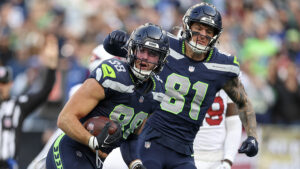 Recap: Barner scores two TDs in Seahawks’ 17-3 win over Cardinals
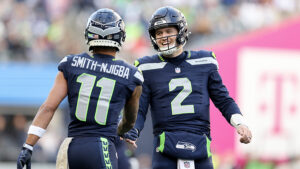 Instant Reaction: Short-handed Seahawks bounce back for win

Comments
0 Comments