

Salk: Mariners have Baseball America’s top system, but how do they capitalize?
Baseball America's latest farm systems rankings feature the Mariners at No. 1. What does it mean? Mike Salk explains and maps out how Seattle must take advantage.

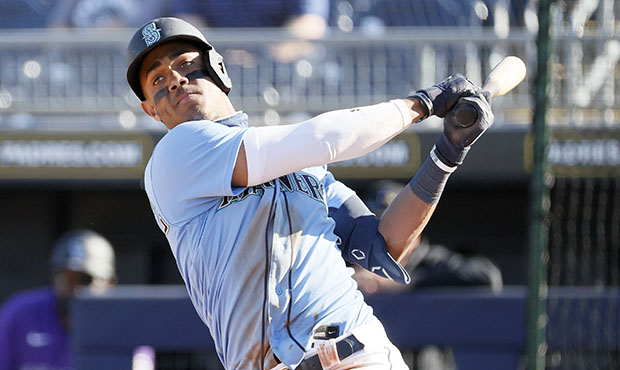
Outfield prospect Julio Rodríguez leads the Mariners' top-ranked farm system. (Getty)
(Getty)
The Mariners now have the top-rated farm system in all of baseball according to industry standard Baseball America. Number one. And that does not even include recent graduates Jarred Kelenic, Logan Gilbert, Jake Fraley or Taylor Trammell.
M’s Takeaways: Servais on France’s defense, Kelenic’s ABs, Gonzales
To get to that point, they need to both have top-rated prospects (including three in the top 15) and organizational depth. And to put this accomplishment in context, three years ago they were rated dead-last.
Obviously, this a tremendous achievement for Mariners general manager Jerry Dipoto and his entire staff. They used trades, international signings, and the draft to build up a barren system. They have also invested in the development of their prospects, which has helped them succeed along the way.
Now there are a few ways to look at this. One is that prospects don’t always translate to success, even when they are top-rated. We know the history of Justin Smoak, Dustin Ackley and Jesus Montero. We’ve seen the big league struggles of both Kelenic and Trammell already this year not to mention the health concerns for Kyle Lewis. Sometimes that happens with prospects.
But while we don’t know how many will pan out, we can see some of the immediate benefits of a having a system of this quality.
• 1. They have a better chance at hitting on a star. You can survive a few flameouts because of the sheer number of chances you have for success. While it is unlikely that every one of their top prospects lives up to their full potential, it is also unlikely that all of them will fall short. The more chances you have for success, the better off you are!
• 2. They can create competition. Baseball isn’t football, but I think Pete Carroll would support the idea of going with the players that earn it. The Mariners can afford to be patient with their young players but they don’t need to depend on any one of them because they have other options hopefully nipping at the heels.
• 3. They are (hopefully) building a winning culture. Look, it’s no secret that the Mariners haven’t had the best reputation. Former team president Kevin Mather certainly added the cherry on top of the reputational sundae that had been curdling for years. So the “Mariner Way” has never been synonymous with long-term success, yet manager Scott Servais has done an excellent job of building a winning culture at the major league level, and I would hope that having this much talent together in the system would allow the players to feed off of each other more than the sins of past upper management. Winning tends to breed good culture and talent tends to lead to wins. This is one way you can change an organizational reputation.
• 4. They have organizational depth. This means that they have long-term internal solutions to the injuries and random off-years that always lurk. If you want to win big, you need to have plenty of options for dealing with setbacks. A strong farm system makes that infinitely easier and will be necessary to really compete.
• 5. They can use their chips to buy the ace (and vets) they need to make this real. And do so without depleting their system. (More on this to follow.)
Overall, having the top system in baseball is a really, really good thing. It is the foundation that a team needs to win, but it is not the same thing as winning. The lousy state of their system was one of the reasons they opted to tear everything down after 2018. Having it built back up gives them the license to truly go for it, and in fact it demands that they do.
The way to pay this off is to add around this core. To self-scout, determine which players will succeed (and which won’t), and to give this group the help it needs.
Two of the best recent models for rebuilding success are the Cubs and Astros. Both built a strong young core and then added around it.
The Cubs had Anthony Rizzo, Kris Bryant, Javier Báez and Kyle Schwarber, and then they spent for Jon Lester. The Astros had George Springer, José Altuve, Alex Bregman and Carlos Correa, and they traded for/spent on Justin Verlander. The only real ace available in free agency this year is Clayton Kershaw and that may be a moonshot, but that is the kind of conversation the Mariners should be having.
Those teams also added some mid-level vets who paid off for them. Ben Zobrist, Jason Heyward, John Lackey, etc. in Chicago. Brian McCann, Josh Reddick and Carlos Beltrán in Houston. All played roles in World Series victories.
The Mariners need to do both of those things beginning this offseason, continuing through next year’s trade deadline and the following year as well. The window is now opening. By this offseason, they need to start climbing through it – or better yet, jumping through with both feet.
The good news is they have money and the organizational assets that make it both easy and worthwhile.
O’Neil: Mariners not handing spotlight over to Seahawks just yet
Related
 Brock: Where Seahawks QB Jalen Milroe needs to improve
 Salk: What’s enlightening about Seahawks going into this season
 3 reasons why Brock likes Seahawks’ Terrion Arnold signing
 Why Brock says UW Huskies will be ‘very relevant’ in CFP conversation
 The Seahawks’ most impressive player at training camp is clear
 Huard: 3 thoughts on Seahawks’ interest in CB Terrion Arnold


Comments
0 Comments