

United States fans seeing red over Balogun’s World Cup red card
United States fans and players are frustrated by a second-half red card that sent off star striker Falorin Balogun and will sideline him for Monday's match in Seattle against Belgium.
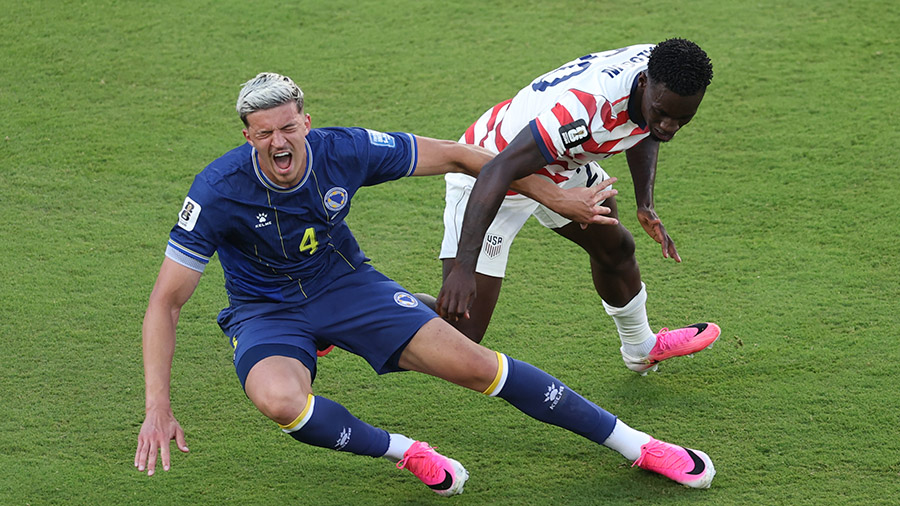
Folarin Balogun of the United States fouls Tarik Muharemovic of Bosnia and Herzegovina in a FIFA World Cup 2026 Round of 32 match on July 1. (Michael Steele/Getty Images)
(Michael Steele/Getty Images)
The Americans are seeing red over the most controversial and consequential red card so far in the World Cup.
World Cup: US to face Belgium in Seattle in Round of 16
While the United States celebrated a 2-0 win over Bosnia-Herzegovina, fans and players were angry and frustrated by a second-half red card that sent off star striker Falorin Balogun. It will sideline him for the next match against Belgium on Monday.
More angles of the red card shown to Balogun and the US 🟥 pic.twitter.com/Rh4zjoJTHI
— FOX Sports (@FOXSports) July 2, 2026
The penalty, called after the referee watched a video replay, ignited debate over whether it was too harsh and whether other players, most notably Argentina’s Lionel Messi, have unfairly avoided similar punishment.
What is a red card and how to earn one
Red cards are the most serious form of punishment in a referee’s pocket. A red card does more than just send a player out of the game. It also means the team can’t replace them and must play shorthanded. The ejected player is also suspended for the next match — and sometimes longer depending on the offense.
The red and yellow card system of discipline was invented after the 1966 World Cup by former referee Ken Aston, who came up with the color-coded level of discipline while stopped at a traffic light.
“I thought, ‘Yellow, take it easy; red, stop, you’re off’,” said Aston, who died in 2001.
Much is left to the referee’s discretion in the heat of play. A player who receives a second yellow card during a game is automatically ejected with a red card. Direct red cards usually result from more serious offenses, such as dangerous tackles and violent play.
Under FIFA rules, “Any player who lunges at an opponent in challenging for the ball from the front, from the side or from behind using one or both legs, with excessive force or endangers the safety of an opponent is guilty of serious foul play.”
Balogun’s red card sparked a debate over whether the foul should have been deemed intentional or just a hard tackle that would have justified a warning with a yellow card.
“It never was intentional,” U.S. coach Mauricio Pochettino said. “If the intention is to damage the opponent, OK, I understand. But that never was. It was a normal action in football that you are fighting for the ball and your feet land.”
The use of video review
The referee has the challenge of watching all the action all the time. In a tangle of bodies, something could be missed. FIFA introduced the use of Video Assisted Review, or VAR, in the World Cup in 2018.
In Balogun’s case, Brazilian referee Raphael Claus didn’t initially signal a card. But an order from the VAR officials to review the replay in slow motion resulted in the red card.
That sparked another debate of whether the play looked worse and more intentional in slow motion.
Former France striker Thierry Henry, now a studio analyst for the World Cup with Fox Sports, criticized the red card.
“You need to have some common sense,” Henry said. “Where is the player supposed to put his foot there in that situation?”
There is no path to appeal – Balogun has to sit one out
As it stands, Balogun will miss the next game but could return for the quarterfinals if the U.S beats Belgium to advance.
There is no appeal for a red card suspension unless FIFA assesses a penalty of more than one game. FIFA could increase the ban if it believes the challenge deserves a harder punishment.
Portugal star Cristiano Ronaldo avoided missing games in the World Cup after a serious red card incident in qualifying. FIFA instead determined two games of a three-match ban would be deferred during a one-year “probationary” period. Ronaldo missed only a 9-1 win over Armenia.
Are star players getting favorable treatment?
Critics have been raising this question since the start of tournament as some of the top players have been entangled in questionable plays, most notably Messi.
In Argentina’s first match, Messi’s studs-up challenge from behind caught Algeria defender Aissa Mandi on the calf and Achilles tendon. It left Mandi rolling on the ground and clutching his leg.
Messi immediately put his arms up like he didn’t mean to hack Mandi’s leg. Algeria was awarded a free kick but the tournament’s biggest star wasn’t booked, stayed in the game finished with a hat trick.
Video clips of the Messi foul began flying around social media by the next day, and caught fire again after the Balogun red card.
American defender Weston McKennie called the red card against Balogun “disappointing.” Balogun is the top scorer for the U.S. with three goals.
“I think there’s been many other plays like that throughout the tournament on other players that a card wasn’t given at all,” McKennie said.
Welcome to World Cup controversy
The American aren’t the first to howl over a red card and won’t be the last. The complaints come after send-offs and no-calls alike.
In 1998, England’s David Beckham was dismissed in the second half of a round of 16 match against Argentina for tripping Diego Simeone in retaliation. In 2006, England’s Wayne Rooney was sent off of a quarterfinal loss to Portugal after he stomped prone Portuguese defender Ricardo Carvalho in the groin.
The most famous World Cup red card sent France legend Zinedine Zidane out of the 2006 final after he headbutted Italy’s Marco Materazzi. Italy would win on penalty kicks.
The most famous non-call came in the 2010 final when the Netherlands’ Nigel de Jong wasn’t sent off for his studs-up kick into the chest of Spain’s Xabi Alonso in the first half. Spain would win in extra time.
AP Sports Writer Josh Dubow contributed.
A heat dome engulfs World Cup games in US this week
Related
 NBA suspends Steve Ballmer 1 year as part of sweeping punishment for Clippers
 Seattle Sports Radio Info: How to find Friday’s Mariners, Seahawks games
 Seattle Sports Radio Info: How to find Saturday’s Seahawks, Mariners games
 Russell Westbrook, one of the last Sonics draft picks, retires from NBA
 NBA’s Lakers to be sold for record-breaking $12.5 billion
 Trail Blazers reps meet Portland officials to discuss Moda Center
Comments
0 Comments