

Three things from the Seahawks’ Super Bowl loss to Patriots
Three things we learned and three things we're still trying to figure out after the Seahawks lost in the Super Bowl 28-24 to the New England Patriots.
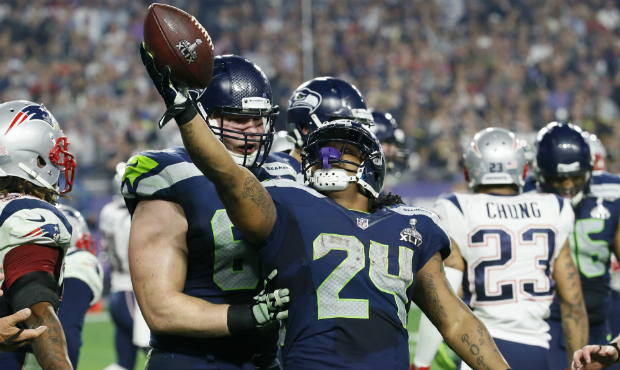
With the Seahawks' season over, focus has shifted back to whether or not Marshawn Lynch will return. (AP)
(AP)
Painful as it was, Sunday’s loss did teach us a few things about Seattle’s team – both how it was built this season but also raising some issues for the future.
Three things we learned:
1. Pete Carroll’s aggressiveness cuts both ways.
The result of Sunday’s Super Bowl was crushing not just because Seattle was stopped 1 yard away from victory, but because the Seahawks were stopped without the ball in the hands of Marshawn Lynch. But what everyone must understand is that the process Seattle used to dial up that final pass play is the same process that resulted in Seattle’s game-tying touchdown in the final seconds of the first half and the touchdown the Seahawks scored off a fake field-goal attempt in the NFC Championship Game. Carroll doesn’t pick plays with an eye toward minimizing the downside, and in this case, that put Seattle in jeopardy. Not because the Seahawks passed. There was sound clock-management strategy in throwing the ball on either second or third down. The problem was the kind of pass Seattle called, running a slant out of a tight formation in an already compressed area of the field. It was risky. As we all saw.
2. Injuries finally caught up to Seattle’s secondary.
It has been a season-long trend as three different cornerbacks missed multiple games because of injury during the regular season: Jeremy Lane (seven games, groin; two games, leg), Byron Maxwell (three games, calf) and Tharold Simon (five games, knee). Three other defensive backs were playing with significant injuries in the Super Bowl: Earl Thomas (shoulder), Richard Sherman (elbow) and Kam Chancellor (knee). When Lane suffered a severely broken arm in the first half, Maxwell and Simon were the only two defensive backs on the field for the defense who could’ve been considered totally healthy. So before anyone goes and wonders just how Seattle allowed Tom Brady to throw for a pair of fourth-quarter touchdowns – or let Aaron Rodgers drive for a game-tying field goal in the final 80 seconds one game earlier – consider what it took for those guys just to be on the field.
3. Seattle needs to deepen its pool of talent at wide receiver.
This is not a commentary on Doug Baldwin’s adequacy at wide receiver. (Seriously, Doug: IT IS NOT A COMMENTARY ON YOUR ABILITY.) He’s a player who could average 80 receptions in a more pass-oriented offense. But consider the talent Seattle has lost outside over the previous two seasons – Sidney Rice retired, Golden Tate left as a free agent, Percy Harvin fought his way out of town and Paul Richardson suffered a serious knee injury. Seattle’s offense doesn’t throw a lot, but when it does, it looks for big plays. It needs more receivers capable of big plays. Again, that’s not a question of the talent on hand, but the need to deepen that pool with size or speed. Or perhaps size and speed. Chris Matthews looked great, which was encouraging, but there’s room for more given that of the five receivers active for Seattle in the Super Bowl, none were drafted into the league.
Three things we’re still trying to figure out:
1. How did Russell Wilson play in the Super Bowl?
This isn’t about the final play. He made the right read on the slant and a good throw to Ricardo Lockette. Malcolm Butler simply made a better play, exploding through a lane that was open because Brandon Browner jacked up Jermaine Kearse at the line of scrimmage. But how was he the rest of the game? He threw deep effectively, giving his receivers chances to go up and make plays, but he also struggled to find the open man early in the game. Expect the offseason emphasis to be for Wilson to work on his decision-making within the scripted portion of the offensive play in an effort to improve Seattle’s efficiency. Just because Seattle wants to be the best scrambling team in the league doesn’t mean he should be scrambling as often as he does.
2. Will Marshawn Lynch be back with the Seahawks next season?
This is very much a question. He has one year remaining on his contract, but it’s also the same contract he wanted redone a year ago, leading to his absence from all voluntary offseason work and the first week of training camp. He’ll be even more adamant this year. On the day of the Super Bowl, a reporter from the league’s network reported the Seahawks had offered an extension that would have raised his 2015 compensation by $3 million (bringing it to $10 million). Two things about that: There was no mention of any guarantees beyond 2015, and the fact Lynch hadn’t signed that deal means that there’s no reason to think he’s more likely to return. The one positive sign for anyone hoping to see Lynch back (which should be everyone in Seattle) is it showed the Seahawks won’t necessarily insist he play out the final year of his deal. There’s room for compromise, but does Lynch want to listen?
3. Does Seattle need to learn to start faster?
Russell Wilson played more than 26 minutes before he completed his first pass in the NFC Championship Game. It took more than 24 minutes in Sunday’s Super Bowl. While Seattle has proven itself to be a second-half team, both in games and during this season, the inability of the Seahawks to secure an early lead hurts the defense’s ability to rush the passer. Next season, the Seahawks need to consider ways to improve early-game production on offense.
Related
 Seahawks have ‘no concerns’ about Drew Lock’s status vs Raiders
 Rams place star WR Puka Nacua on IR as roster flexibility dwindles
 Seahawks Injury Report: LT Charles Cross returns to practice
 Husky Stadium to be renamed after UW strikes historic deal
 UW Huskies sign two men’s basketball recruits
 Manchester United nearing deal to hire USMNT coach Mauricio Pochettino
Comments
0 Comments