

Latest allegations against Patriots raise suspicion about decisive Super Bowl play vs. Seahawks
Recent reports about the Patriots' history of underhanded tactics and the resulting paranoia around the NFL make you wonder about what might have gone into Malcolm Butler's interception that sealed New England's Super Bowl victory over the Seahawks.
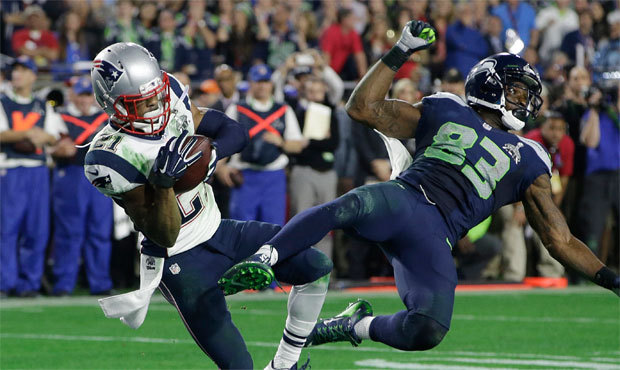
Was Malcolm Butler's goal-line interception the result of something other than honest preparation? (AP)
(AP)
“Preparation. I remember the formation they were in, two receivers stacked and I just knew they were doing a pick route. I knew it was on the line and we needed it, and I just beat him to the route and just made the play.” – Patriots cornerback Malcolm Butler, post-Super Bowl interview
Malcolm Butler could see the play coming, and that was odd because the Seahawks hadn’t run that play.
At least not inside the opponent’s 20-yard line. Not according to Seattle’s coaching staff, and while that doesn’t mean the Patriots couldn’t have prepared for it or recognized some formational tell, it does make you stop and think for a second. At least it does in the wake of a pair of stories that were published Tuesday by the two most influential sports media institutions in our country: ESPN and Sports Illustrated.
The stories were different, ESPN detailing all the hinky stuff the Patriots have been known to do while Sports Illustrated documented the depth of paranoia and conviction regarding what amounts to corporate espionage on the part of the franchise. In fact, the Sports Illustrated story begins with the fact that the Seahawks received calls – unsolicited – prior to playing New England in the Super Bowl last February on how best to protect their preparations.
And after all that, the game was decided on a play in which the Patriots took a sledgehammer to the pattern the Seahawks tried to execute, Brandon Browner jamming Jermaine Kearse at the line and Butler driving through Ricardo Lockette to intercept a pass and seal New England’s victory.
“A play we’d practiced all year,” Lockette recalled later in an essay for The Players’ Tribune. “We ran it three times during the season in the same situation to 100 percent completion. Perfect.”
But the Seahawks had never run it inside the opponent’s 20-yard line. Not according to their coaches.
The point of this story is not to accuse the Patriots of cheating. There’s no proof. But look at the history of allegations that have followed the Patriots around for the past 15 years and it’s impossible not to wonder just a little bit. And now you’re beginning to understand why the issue of the Patriots and their punishment for deflated footballs is so very complicated within the league.
This is a team that is widely believed to use the rulebook not so much as a guide but a weapon, looking for any way to gain an edge, an advantage. It’s why Marty Hurney – the former Panthers general manager – asked directly last January whether there was a culture of cheating at the heart of a Patriots franchise considered to be the league’s gold standard of success over the past 15 years.
The punishment the league handed down for the underinflated footballs discovered in the AFC Championship Game wasn’t about the tactical advantage the Patriots and quarterback Tom Brady may have gained with a softer football. It was about catching a franchise always suspected of cheating in the act. It was like getting Al Capone for income-tax invasion, and the biggest problem the NFL ran into is that if you’re going to use a tax infraction to go after a kingpin, well, you better be able to prove for absolute certain that tax infraction occurred.
The NFL said it had a smoking gun. It turned out to be nothing more than a broken cell phone, and now everyone around the league is trying to make sense of what for all intents and purposes looks to be a railroading of a franchise that just won its fourth Super Bowl in 15 years.
And maybe the all the suspicion aimed at the Patriots is a batch of sour grapes. Football coaches tend toward paranoia, so protective of plans that they cover their mouths while talking on the sideline and develop their own language, a playbook pidgin to communicate without the opponent understanding.
Front offices are no less secretive, but there have been enough instances of the Patriots being nabbed or suspected of shady actions that there’s a deep-rooted suspicion across the league that there is something rotten involved in New England’s success.
That’s why the league tried to throw the book at the Patriots and a four-game suspension at their quarterback, and that’s why Seattle’s final offensive play in last season’s Super Bowl will always raise an eyebrow of skepticism in some parts of the Pacific Northwest.
This isn’t an accusation, just a nagging suspicion. One that makes the skin on the back of your neck crawl when you hear a Patriot player say he knew what was coming.
Related
 Report: Randy Arozarena declines Mariners’ qualifying offer for 2027
 Seahawks waive one of their 2026 NFL Draft picks
 Referees challenged by 2 plays in Seahawks’ win over Raiders
 Hilary Knight scores twice as USA beats Canada for world women’s hockey gold
 The latest on banged-up Seahawks O-line’s injuries going into bye
 Seahawks RB Holani week-to-week with MCL sprain, per report
Comments
0 Comments