

What We Learned: Seahawks’ offense at a five-year low
In his weekly review of the Seahawks, Danny O'Neil puts their offensive struggles in context and wonders if they'd be better suited picking up the pace like they've done at the ends of halves this season.

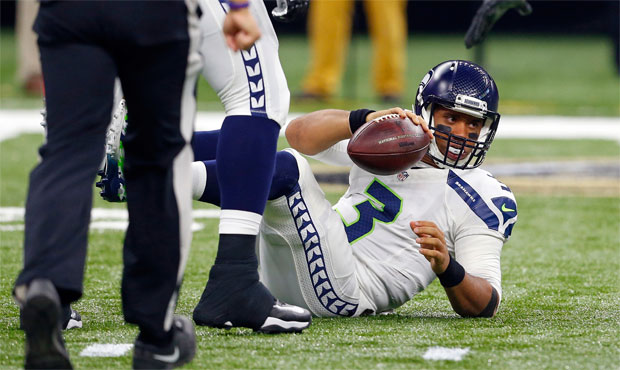
Russell Wilson and the Seahawks have struggled moving the ball until they end up in do-or-die situations. (AP)
(AP)
That the Seahawks’ offense will improve is an act of faith at this point.
Something that draws upon the history of improvement Seattle has shown in November and December under Pete Carroll and the belief that Russell Wilson will recover from the sprained knee that he suffered in Week 3.
But after seven games, there’s no denying the reality that Seattle’s offense is struggling in a way we haven’t seen since Wilson’s first two months as the team’s starting quarterback.
Three things we learned:
1. Seattle’s offensive output has not been this low since Wilson’s rookie year.
The Seahawks’ offense has been known to scuffle its way through the first half of the season, but not like this. At least not since Wilson’s rookie season of 2012. The Seahawks are currently averaging 18.7 points. They averaged at least 22 points through the first seven games in each of the previous three seasons. The fact that 2012 is the last time Seattle’s offense has been this bad in point production is telling because that was back when Seattle was breaking in Wilson, and being very careful not to overload him. Seattle scored fewer than 20 points in five of the first seven games while starting 4-3 that season. Seattle has scored fewer than 20 points in only three of the first seven games, but has failed to score a touchdown twice while starting 4-2-1.
2. The Seahawks’ offense can’t overcome its own mistakes.
The Seahawks were penalized 11 times in Sunday’s loss to New Orleans. Five of those penalties were called against Seattle’s offense, and what is significant is that the Seahawks never gained a first down on any possession after being called for a penalty. They were absolute drive killers in each and every case, including the fourth-quarter penalty against Christine Michael for a false start, which pushed the Seahawks from second-and-goal at the New Orleans 5 to second-and-goal from the 10. Two plays later, the Seahawks kicked a field goal.
3. Seattle has reached the point of diminishing returns with Michael.
Michael should be commended for how hard he has worked to reclaim his NFL career, but the hairline fracture in Thomas Rawls’ leg sucked Michael into a role that he’s not really suited for. Michael has eyes for the big play, which sometimes keeps him from seeing the creases he should be looking for in Tom Cable’s zone-running scheme. It also prevents the kind of consistent gains that keep an offense on schedule. Rawls will miss at least another game, but expect to see rookie C.J. Prosise continue to get more playing time.
Three things we’re still trying to figure out:
1. Can Wilson cut it loose again?
He hasn’t thrown a touchdown pass in three games. He’s also played through an injured ankle, a sprained medial-collateral ligament in his knee that would have sidelined most players a month and most recently a strained pectoral muscle. Through all that, he has taken extraordinary care of the ball, going five completes games and 203 consecutive pass attempts without being intercepted before he was picked off in the first half against New Orleans. The prudence is impressive, but he’s the only one who can steer Seattle’s offense out of this scoring slump. He did it over the final six regular-season games last year when he threw for 24 touchdown passes against just one interception. Seattle needs him to do it again. Now.
2. Can Seattle’s defense remain this resilient all season?
The Saints held the ball for more than 21 of the 30 minutes in the first half, including more than 12 minutes in the second quarter. Pile that on top of the 90 plays that Seattle’s defense was on the field for a week earlier in Arizona and it would be understandable if the Seahawks wilted in the second half. They didn’t. They forced the Saints to settle for a third-quarter field goal after New Orleans had first-and-goal at the 1. The Saints ran an astounding 15 offensive plays from Seattle’s 10 or inside it over the course of Sunday’s game yet New Orleans reached the end zone on only two of them. The first was a 1-yard quarterback sneak from Drew Brees after the Seahawks had snuffed out two New Orleans rushes from the Seattle 1. The second touchdown was scored when Cheatin’ Willie Snead blocked Jeremy Lane into the end zone to keep Lane from covering Brandin Cooks. It was an admirable defensive effort, but is it sustainable? The Seahawks are putting an awfully heavy workload on their defense.
3. Why is the Seahawks’ offense so efficient when it’s a do-or-die situation?
The Seahawks’ final possession in New Orleans, which saw them reach the Saints’ 10, was just the latest time when Seattle found momentum after having its back pushed to the wall. It happened in Week 1 against Miami when the Seahawks came back to score their only touchdown after falling behind 10-6 with just over 4 minutes remaining. It almost happened a week later in Los Angeles until a fumble unplugged the Seahawks’ final possession, and it happened in overtime at Arizona when the Seahawks gained 127 yards on the final two possessions after being held to 130 yards of total offense over the first four quarters. Is it something about the accelerated tempo of those end-of-game situations that helps Seattle’s offense? Is it the limited substitutions or the lack of a huddle? Because whatever it is, the Seahawks are allowed to play like that earlier in the game. In fact, it would be recommended.
Related
 O’Neil: Seahawks have uncertainty with a player ‘holding in,’ but it’s not Quandre Diggs
 O’Neil: Mariners aren’t handing the spotlight over to Seahawks just yet
 O’Neil: When Seahawks decide not to extend players, they’re rarely wrong
 O’Neil: Despite timing, Mariners’ Graveman trade is exactly the kind of move they should be making
 O’Neil: MLB’s handling of Mariners LHP Santiago’s suspension is all wrong
 O’Neil: When it comes to CB Stephon Gilmore, the Seahawks should pass

Comments
0 Comments