

How much of the Cubs’ model should the Mariners follow?
With the MLB offseason officially started, 710 ESPN Seattle's Brock Huard says the Mariners should learn from the overall athleticism that helped the Cubs win the World Series.

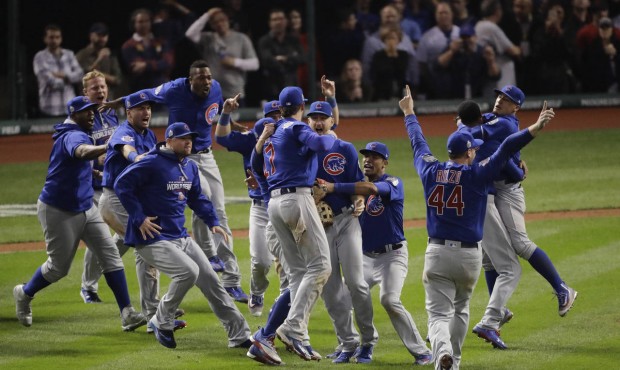
Brock Huard thinks the Mariners roster could use the type of athleticism and speed as the Cubs have. (AP)
(AP)
Mariners GM Jerry Dipoto comes from the Theo Epstein school of team building. Like the Cubs President of Baseball Operations, Dipoto believes in building through the farm system and emphasizing the importance of getting on base and playing good defense. Furthermore, early in his front-office career Dipoto was a scout with Boston when then-Red Sox GM Epstein helped them win their first World Series in 86 years.
But while Epstein’s Chicago Cubs just finished on top in one of the most memorable World Series’ of all time, Dipoto’s Mariners finished on the outside of the postseason. Brock and Salk discussed what’s missing in Seattle and, now that the offseason has officially started, how much more of the Cubs model should the team be following.
“Because, let’s face it, that team is now set up to compete now for the next decade,” Mike Salk said of the Cubs.
Hot Stove Podcast No. 3: The Mariners’ 5 biggest needs
The Cubs were the best team in baseball in 2016, winning 103 games in the regular season and dominating the National League in large part because of having the league’s best pitching staff. They also have a foundation of youth interspersed with veteran pieces that looks similar to what the Mariners are attempting to do. The Cubs were third in the MLB in runs scored but lower in certain major peripherals: 13th in home runs, 14th in batting average, 20th in stolen bases, 21st in fielding percentage. Meanwhile, they ranked No. 1 in walks and No. 2 in OBP.
The Mariners compare favorably in many of these spots, despite playing in notoriously offense-constricting Safeco Field: sixth in runs, third in home runs, ninth in OBP, 10th in batting average, 12th in fielding percentage, 14th in walks and 24th in stolen bases.
So where’s the major difference?
“We like talking about margin for error … the Mariners have got to be faster and more athletic,” Brock Huard said. “This game is hard, it’s hard to hit. You watched the best hitting team in baseball struggle and go inept at times, go asleep even, in the World Series. You need to have some margin.”
While the Mariners leaned heavily on a core of stars mostly in their 30s like Robinson Cano and Nelson Cruz, the Cubs have a several young stars including Kris Bryant, Anthony Rizzo, Addison Russell and Javier Baez, with veterans Ben Zobrist, Dexter Fowler and Jason Heyward mixed in.
Huard says the Cubs’ overall athleticism in their youthful core shown through.
“The Cubs were not built like Cleveland,” Huard said. “They weren’t totally built to be on the basepaths and be warriors and be pressurized in every situation but, holy cow, Kris Bryant’s speed made an enormous difference. He scored two runs in (Chicago’s Game 7 win).”
With all of that said, Huard saw a much better trend in Seattle in 2016 compared to the 2015 season.
“You look at the Mariners and the lack of speed and lack of athleticism in just about every spot a season ago, and how your margin for error is so slim if you don’t pitch perfect in the bullpen or if you don’t hit in clutch situations,” he said. “Who can run? Who can pressurize? Who can really challenge? I know it’s important to them to make a real priority of getting more athletic and faster.”
Related
 Daniel Jeremiah: What makes Seahawks’ defense different
 Seahawks’ Julian Love making case he’s an ‘elite’ safety
 When is the right time for Seahawks’ Sam Darnold to return?
 Seahawks QB Sam Darnold has ‘chance’ to return this week
 Even in limited snaps, Seahawks’ Emmanwori makes ‘impact’ in return
 What John Forslund wants to see from Kraken in Year 2 of Lambert era


Comments
0 Comments